
The CEO of a large industrial company gave the year’s kickoff speech. He spoke proudly of the previous year’s achievements. He acknowledged that hard times were coming, maybe harder still. He told several inspiring stories about how every obstacle hides an opportunity.
After more than an hour, he closed with a request to the entire staff: cut costs, improve quality, innovate, raise the level of service, and have a more positive attitude.
He left satisfied, convinced he had lit a fire in his people. Until the next day, when he overheard a conversation between two supervisors.
“Did you hear the CEO’s speech yesterday?”
“No, I just got back from vacation. What did he talk about?”
“Honestly, not sure. But I think they’re going to lay us all off.”
This anecdote has been circulating in HR and sales circles for years. It describes a problem far more common than it seems: the gap between what a leader believes they communicated and what their team actually understood.
The Three Requirements of an Objective
What I learned many years ago in marketing is that an objective, to earn the name, needs three things measured: the intent, the magnitude, and the deadline.
The intent is what you want to do. Sell, grow, retain, add clients.
The magnitude is how much. A number, a percentage, a concrete quantity.
The deadline is by when. A date, not “this year” or “soon.”
By that measure, most of what companies call an objective is not one:
→ “Sell more” has intent and nothing else. Not an objective.
→ “Grow 30%” has intent and magnitude, but with no deadline it is still not an objective. A 30% by March or 30% over three years? That changes everything.
→ “Grow revenue 30% by December 31” is finally an objective. All three requirements are there.
When all three are present, anyone on the team can put their own work and their own sales effort in context. When one is missing, each person fills the gap their own way, and that is where the problems start.
The Back of the Card
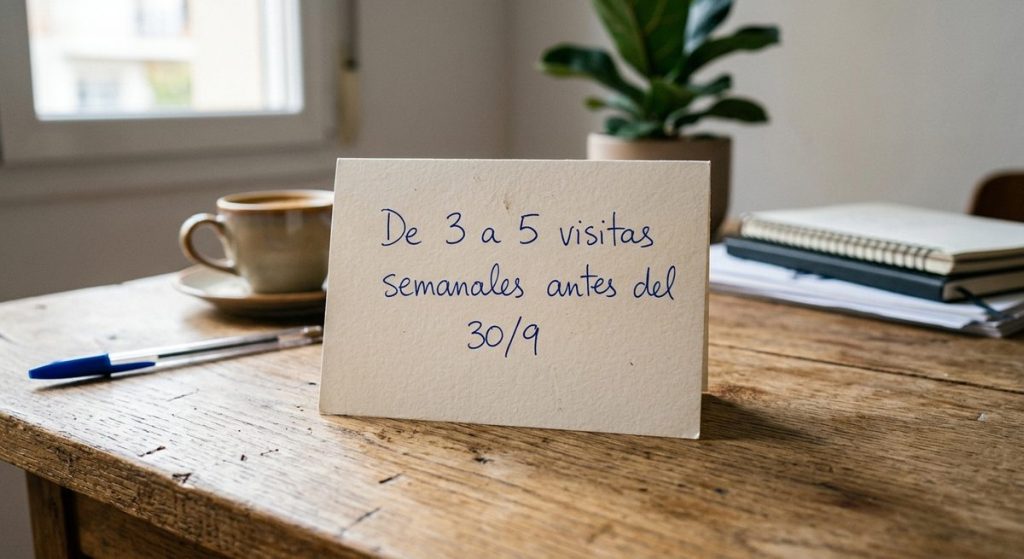
The practical rule I have used for years: if the objective, with its three requirements, does not fit on the back of a business card, it is not an objective yet. It is a speech.
Intent, magnitude, and deadline fit comfortably in a single sentence. “Go from 3 to 5 weekly sales visits per rep by September 30” is one line, and everything is there. If explaining the goal takes a paragraph, it means you have not yet decided on one of the three things.
This is not brevity for tidiness. The short sentence forces a decision. When you have to pick a single number and a single date, the questions the long speech leaves buried come to the surface: what exactly are we measuring? against what baseline? who is responsible?
Edwin Locke and Gary Latham, the most cited researchers in goal-setting theory, arrived at the same place by another route: specific goals guide action far better than vague ones, and the way to make them specific is to attach a number and a deadline.
Why This Matters to Anyone Designing an Incentive Program

In nearly three decades building incentive programs and reward trips at AV Business & Communication, I have seen entire campaigns built on an objective so broad that no one on the team knew precisely what they had to do to earn it.
The prize, however attractive, does not fix a badly written objective. It exposes it. The nicer the trip, the more obvious it becomes that the rules for winning it were unclear. People end up competing for something they do not understand, and the program meant to motivate breeds distrust instead.
Before thinking about the trip destination, the bonus amount, or the campaign design, it is worth doing one exercise: write the objective in a sentence with the three requirements, intent, magnitude, and deadline. Show it to three people on the team separately and ask them to repeat it in their own words. If the three versions match, the objective is ready. If each one understood something different, there is still work to do before launching anything.
The Right Order
Objective first. Prize second. Never the other way around.
An incentive program does not start by choosing the destination. It starts with a sentence the whole team can repeat without checking their email. That is the least glamorous work and the one that most determines whether the campaign will work.
If your company is putting together an incentive program and cannot quite pin down the concrete objective to be rewarded, we can help you get it into a single sentence before thinking about the rest.
Write to us at [email protected] or fill out the contact form.
Alejandro Verzoub, President of AV Business & Communication. Argentina’s first full-service incentive & marketing company.